Nobody Was in the Room
October 10, 2026
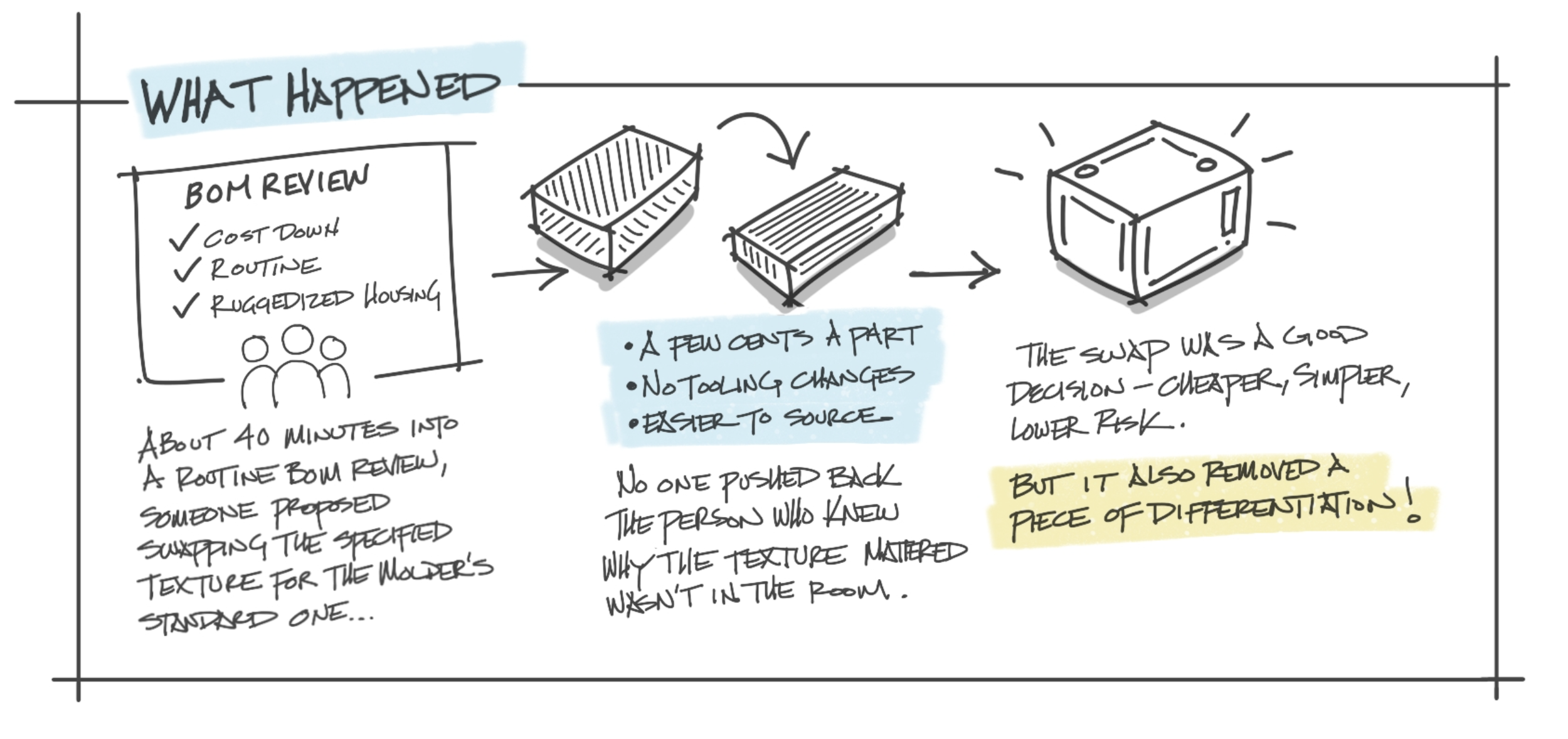
A while back I sat in on a BOM review for a ruggedized housing. Cost-down pass, routine, the kind of meeting that happens on every program.
About forty minutes in, someone proposed swapping the specified texture for the molder's standard one. A few cents a part, no tooling changes, easier to source.
Nobody pushed back. The texture had been chosen fourteen months earlier for a specific reason, and nobody at that table remembered what it was. The person who did wasn't in the room.
That swap was a good decision. Cheaper, simpler, lower risk, and defensible by every criterion available to the people making it. It was also the moment a piece of the product's differentiation quietly left the program — and it left without an argument, because there was nobody there who could have made one.
The asymmetry
Here's the uncomfortable structure underneath that meeting.
Whoever is driving a decision is, by definition, the person least able to see what it forecloses. They're looking at their own constraint, and they're looking at it well. The cost of the decision lands somewhere they aren't looking — on a surface, in a tool, on a board, in a mount — and it lands in a discipline that has no reason to be watching that particular meeting.
So the person who could have caught it is never the person making the call. That isn't a failure of diligence. It's the shape of the problem.
Which means catching it can't depend on someone being alert. It has to be structural.
And this is the thing most teams get wrong about "differentiation dying." It doesn't die at concept, or at the strategic review, or in some dramatic moment where the wrong direction gets chosen. It dies on a Tuesday afternoon, forty minutes into a routine meeting, in a decision that was correct on its own terms.
Two seats, not a review board
The structural version is a rule: nothing advances to the next constraint until the discipline that wasn't driving has signed off.
Not a phase gate. Not a design review. A named second discipline, on that specific decision, confirming that it doesn't cost them something the program can't afford.
It's cheap because it's two people. The constraint is fresh, one of them just did the work, and the conversation takes twenty minutes — often less, and often not a meeting at all. A message, a screen share, a walk over to someone's desk.
Add a third discipline and the economics invert. Somebody is unavailable, so it goes asynchronous. Asynchronous needs an artifact, so someone builds a deck. A deck needs a slot on a calendar. And the moment confirmation fires on the calendar rather than when the constraint resolves, it is a phase gate — which is the thing you were trying to get out from under.
So the seat count matters more than it looks. Two is a conversation. Four is a committee, and a committee confirms nothing: if the review misses something, the review missed it, and nobody in particular was responsible for catching it.
This is also, quietly, why the formal methods for this don't get used at mid-market scale. Large organizations solve the same problem with systems engineering functions and dependency analysis. That machinery works, and it doesn't scale down to a team of twelve with one prototype budget. The small-team version isn't a lighter process. It's a different mechanism — one that only works because the team is small enough for confirmation to stay a conversation.
Where the rule breaks
There's one arrangement where this can't run at all, and it's common enough to be worth naming.
Split the scope across two vendors — one firm on industrial design, another on engineering — and the confirmation has a contract boundary sitting exactly where it needs to fire. Neither firm is staffed to watch the other's foreclosures. Neither is paid to slow down for them. And when something gets closed off, the cost lands on the client, who is the only party who can see it and the only one not in the room.
The same thing happens inside a single company when the disciplines sit far enough apart, or when one of them is brought in late. It isn't about org charts. It's about whether both disciplines are live on the program at the same time, on the same decision.
Which is the real argument for staffing them in parallel. Not that it's more collaborative. That the confirmation is unrunnable otherwise.
Back to the texture
The swap in that BOM review was catchable. It would have taken one person, five minutes, and the answer would have been either that's fine, it was never load-bearing or no — here's what that texture was doing.
Either answer is a good outcome. The bad outcome is the one that happened: no answer, because no question, because nobody in the room could have known there was one to ask.
On your last program, how many of those went by?
You won't be able to name them. That's the point — a foreclosure nobody saw doesn't leave a mark in the record. It shows up eighteen months later as a product that doesn't quite feel like the one the team set out to build, and no one can say exactly where it went.